Bladder Cancer Glossary
Medical language can feel like another language entirely. This glossary explains the words and terms most commonly used in bladder cancer care: from the first appointment through to treatment and follow-up. Use this page as a reference whenever you come across a word you are not sure about.
If your doctor or nurse uses a term that is not here, do not hesitate to ask them to explain it in plain language. There are no silly questions.
Bladder Cancer Glossary
- Adenocarcinoma: A rare type of bladder cancer that starts in gland-like cells in the bladder wall.
- BCG: Bacillus Calmette-Guerin. A type of bacteria placed into the bladder to stimulate the immune system to attack cancer cells. The most effective intravesical treatment for high-risk NMIBC.
- Biopsy: The removal of a small piece of tissue from the bladder during a procedure. The tissue is then examined under a microscope to check for cancer cells.
- Bladder: A hollow, muscular pouch in the lower abdomen that stores urine until it is ready to leave the body. It expands as it fills and contracts when you urinate. Most bladders hold around half a litre of urine.
- Bladder cancer: A disease in which cells in the bladder grow in an uncontrolled way and form a tumour. It usually starts in the inner lining of the bladder.
- Catheter: A thin, flexible tube used to drain urine from the bladder or to place medicine into it.
- Chemotherapy: Medicines that kill fast-growing cells, including cancer cells. May be given directly into the bladder, by drip into the bloodstream, or before surgery to shrink a tumour.
- CIS (carcinoma in situ): A flat, high-grade tumour that looks like an inflamed patch on the bladder lining. It is not a lump but it is aggressive and more likely to spread if not treated. Around 1 in 10 people with bladder cancer have CIS. Also written as TIS.
- Clinical nurse specialist (CNS): A specialist nurse with expert knowledge in bladder cancer care. Often a key point of contact for patients, providing information, support, and coordination.
- Clinical trial: A research study that tests new treatments in people. Participation is voluntary and may give access to treatments not yet widely available.
- Complete response: When treatment has been fully successful and no cancer can be detected. Continued monitoring is still needed, as the cancer may return.
- CT scan: A detailed X-ray that produces cross-sectional images of the body. Used to see whether bladder cancer has spread to other organs or lymph nodes.
- CT urogram: A specific type of CT scan that uses a contrast dye to produce detailed images of the entire urinary tract: kidneys, ureters, and bladder.
- Cystoscopy: A procedure in which a doctor passes a thin, flexible tube with a camera through the urethra to look inside the bladder. It is the main way bladder cancer is diagnosed.
- Early menopause: Menopause brought on by the surgical removal of the ovaries, which may be part of a radical cystectomy in women. Can cause hot flushes, mood changes, bone loss, and other symptoms.
- Fatigue: Extreme tiredness that does not go away with rest. A very common side effect of cancer and its treatment.
- Grade: A measure of how abnormal the cancer cells look under a microscope, and how quickly they are likely to grow.
- Haematuria: The presence of blood in the urine. It may be visible (making the urine look pink, red, or dark brown) or only detectable under a microscope. It is the most common symptom of bladder cancer, experienced by around 8 in 10 people diagnosed.
- High grade: Cancer cells that look very different from normal. They grow more quickly and carry a higher risk of spreading or coming back.
- Ileal conduit: A short tube made from a piece of the small bowel, used to carry urine from the ureters to a stoma on the abdomen. The most common type of urinary diversion after radical cystectomy.
- Immunotherapy: Treatment that uses the body’s own immune system to recognise and destroy cancer cells. In bladder cancer this includes BCG and systemic immunotherapy medicines given by drip.
- Incontinence: Difficulty controlling the bladder, which can result in leaking urine. A possible side effect of surgery or radiotherapy. Pelvic floor physiotherapy and specialist advice can help.
- Intravesical therapy: Treatment where medicine is placed directly into the bladder through a catheter, rather than taken by mouth or given into the bloodstream. Used for non-muscle-invasive bladder cancer.
- Kidneys: Two bean-shaped organs that filter the blood and remove waste, producing urine as a result.
- Low grade: Cancer cells that look similar to normal bladder cells. They tend to grow slowly and are less likely to spread.
- MDT: Multidisciplinary team. A group of healthcare specialists who meet to agree the best treatment plan. In bladder cancer, the MDT typically includes a urologist, oncologist, radiologist, pathologist, and specialist nurse.
- Metastasis: When cancer cells spread from the bladder to other parts of the body, such as the lymph nodes, lungs, liver, or bones. Also described as ‘metastatic’ or ‘advanced’ bladder cancer.
- MIBC: Muscle-invasive bladder cancer. The cancer has grown through the lining and into the muscle of the bladder wall. This more serious form makes up about 25–30% of diagnoses.
- MRI scan: Uses magnetic fields and radio waves to create detailed images of soft tissues. Useful for assessing how deeply a tumour has grown into the bladder wall.
- Neoadjuvant chemotherapy: Chemotherapy given before surgery to shrink a tumour and reduce the risk of the cancer coming back.
- Neobladder: A new bladder constructed by surgeons from a section of the bowel, placed inside the body and allowing urine to leave through the urethra as before.
- NMIBC: Non-muscle-invasive bladder cancer. The cancer is only in the inner lining of the bladder and has not spread into the bladder muscle. This is the most common form, making up 70–75% of diagnoses.
- Oncologist: A cancer specialist. In bladder cancer care, a medical oncologist may oversee chemotherapy or immunotherapy, and a clinical oncologist may oversee radiotherapy.
- Palliative care: Specialist care focused on improving quality of life and managing symptoms. It can be provided at any stage of cancer, not only at end of life.
- Papillary tumour: A tumour that grows out from the bladder lining on a stalk, like a tiny finger. It tends to grow into the open space inside the bladder rather than into the wall.
- Pathologist: A doctor who examines tissue and cell samples under a microscope to diagnose disease and determine the type, stage, and grade of cancer.
- Pathology report: A written report produced after examining tissue removed during a procedure. It confirms the type, stage, and grade of your cancer.
- Pelvic floor: The group of muscles that support the bladder, bowel, and uterus. Strengthening the pelvic floor through physiotherapy can help manage urinary incontinence after treatment.
- Progression: When bladder cancer advances to a more serious stage, for example, from non-muscle-invasive to muscle-invasive despite treatment.
- Prostate: A small gland in men that sits just below the bladder and surrounds the urethra. It can be affected by bladder cancer surgery.
- Radical cystectomy: An operation to remove the entire bladder. Used for muscle-invasive bladder cancer or high-risk NMIBC that has not responded to other treatments. Surgeons will create a new route for urine to leave the body.
- Radiotherapy: Treatment that uses high-energy beams to kill cancer cells or shrink tumours. Can be used instead of surgery for muscle-invasive bladder cancer, or alongside chemotherapy.
- Recurrence: When cancer comes back after treatment. Bladder cancer has a higher rate of recurrence than many other cancers, which is why regular follow-up appointments are so important.
- Renal pelvis: The funnel-shaped area inside the kidney where urine collects before passing into the ureter.
- Re-TURBT: A second TURBT procedure a few weeks after the first, usually for high-grade NMIBC, to ensure all tumour tissue has been removed and to get accurate staging.
- Sessile tumour: A tumour that is flat against the bladder lining rather than growing on a stalk. Sessile tumours are harder to see and more likely to grow deeper into the bladder wall.
- Sexual dysfunction: Changes to sexual function that may occur as a result of surgery, radiotherapy, or other treatments. Affects both men and women, and is an important consideration when choosing treatment.
- Squamous cell carcinoma: A less common type of bladder cancer, often linked to long-term bladder inflammation or parasitic infection.
- Stage: A description of how far the cancer has grown or spread. Bladder cancer stages run from Ta (very early, only in the lining) through to T4 (spread to nearby organs).
- Surveillance: Regular monitoring after bladder cancer treatment to check whether the cancer has come back. Typically involves periodic cystoscopies and urine tests.
- T1: The tumour has grown through the lining into the connective tissue just beneath it, but has not yet reached the bladder muscle.
- T2: The tumour has grown into the muscle of the bladder wall.
- T3: The tumour has grown through the muscle and into the fatty tissue surrounding the bladder.
- T4: The tumour has spread into nearby organs, such as the prostate, uterus, vagina, or pelvic wall.
- Ta: The tumour is only in the lining of the bladder and has not grown into the wall beneath.
- Targeted therapy: Medicines that specifically target abnormalities within cancer cells to stop them growing. Used for advanced or metastatic bladder cancer.
- TIS / CIS: A flat, high-grade tumour in the surface lining (carcinoma in situ). Despite being classified as early-stage, it is aggressive.
- TURBT: Transurethral Resection of Bladder Tumour. The most common operation for bladder cancer. A surgeon passes a thin instrument through the urethra and removes the tumour. No cuts are made in the skin. Used both to diagnose and to treat bladder cancer.
- Ureters: Two thin tubes, one on each side, that carry urine from the kidneys down to the bladder.
- Urethra: The tube that carries urine out of the body from the bladder. In men it runs through the prostate and penis; in women it is much shorter.
- Urinalysis: A basic laboratory test of a urine sample that checks for blood, infection, and other abnormalities. Often one of the first tests done when bladder cancer is suspected.
- Urinary diversion: A surgical procedure that creates a new route for urine to leave the body after the bladder has been removed.
- Urinary tract infection (UTI): An infection in the urinary system. UTIs share symptoms with bladder cancer, which can sometimes cause delays in diagnosis. Having a UTI does not rule out bladder cancer.
- Urine cytology: A laboratory test that examines cells shed into the urine. It can detect cancer cells, though it is more reliable for high-grade cancers.
- Urologist: A doctor who specialises in diseases of the urinary tract. Usually the lead specialist for bladder cancer diagnosis and surgical treatment.
- Uro-oncologist: A urologist with specialist training in urological cancers, including bladder cancer.
- Urostomy / stoma: An opening created in the abdomen through which urine drains into an external pouch worn on the skin. One option for urinary diversion after the bladder is removed.
- Urothelial carcinoma: The most common type of bladder cancer, starting in the urothelial cells that line the bladder. Also sometimes called transitional cell carcinoma (TCC).
- Urothelial cells: The special cells that line the inside of the bladder, ureters, and part of the kidneys. Also called transitional cells. Bladder cancer almost always starts in these cells.
- UTUC: Upper tract urothelial carcinoma. A cancer that starts in the same type of cells as bladder cancer, but in the kidney (renal pelvis) or the ureter rather than the bladder.
Not sure about a word not listed here?
If you see or hear a term that is not in this glossary, the best source of explanation is always your own medical team. You can also contact us at patients@worldbladdercancer.org and we will do our best to help.
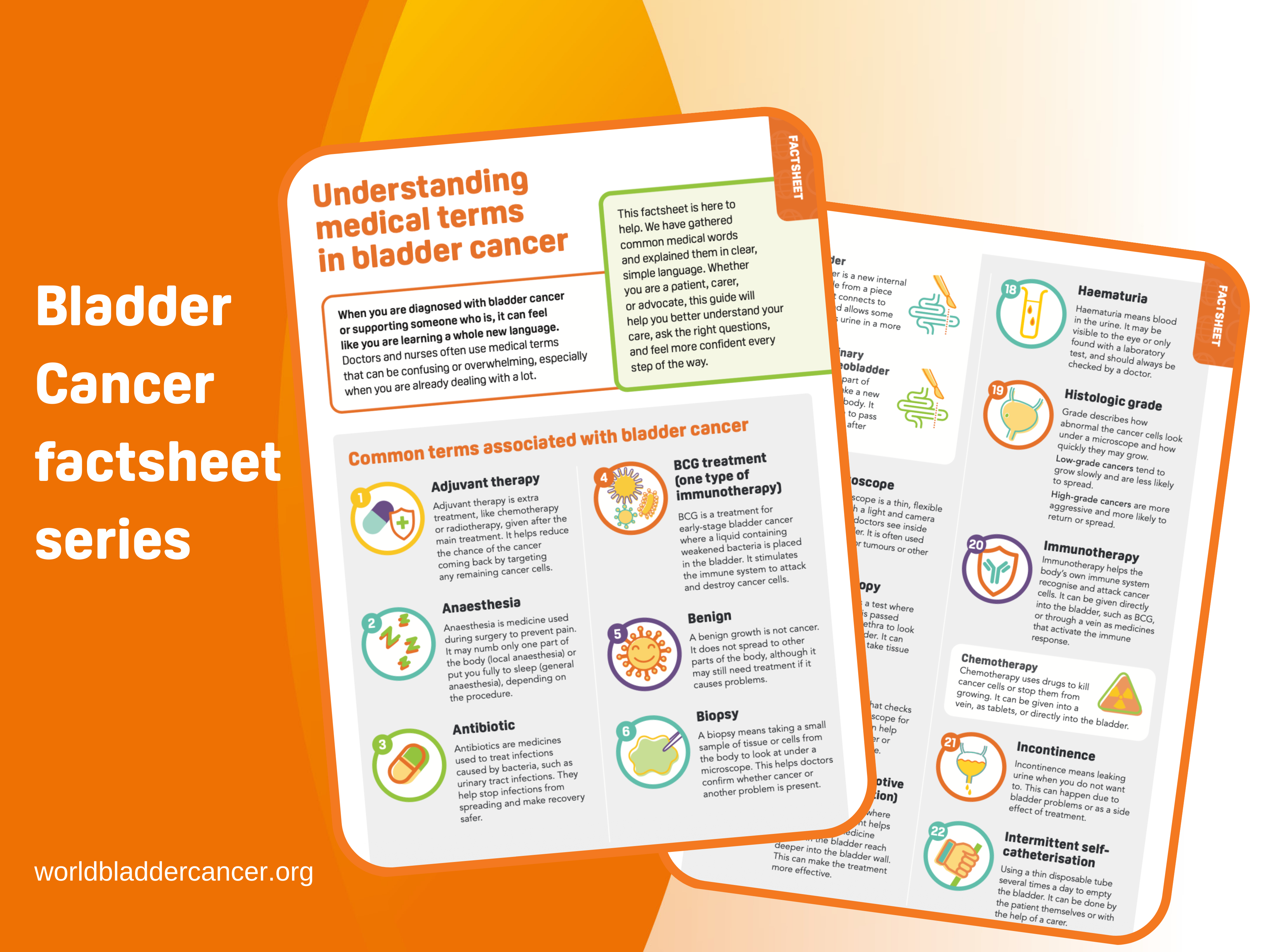
Factsheet: Understanding medical terms in bladder cancer
Factsheet: What is Bladder Cancer?

Factsheet: Recognising the symptoms of bladder cancer

Factsheet: Understanding the risk factors of bladder cancer